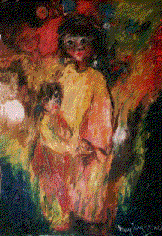
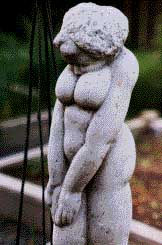
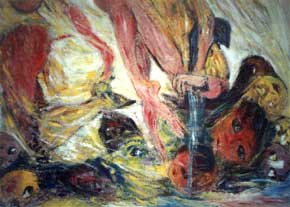
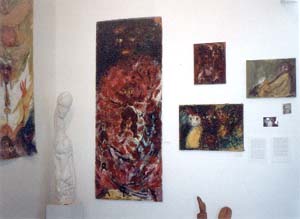
Painter and sculptor Mary Perry Stone has lived in Ashland, Oregon since 1992. Born in Jamestown, Rhode Island on May 9,1909, she first went to New York City at fifteen to attend the Art Students League. Returning to Rhode Island to finish high school, she knew she wanted to return to New York City and study art. Her practical-minded sister arranged for her to attend Traphagen School of Fine Arts and Design In NYC. Traphagen guaranteed its graduates a job, but when Mary finished her course in 1934 there were no jobs available.
Joining the thousands of other workers without jobs in "The Great Depression," she struggled with both the Relief Bureau and finding work. The social unrest and political struggles of the Thirties influenced how she saw the world. Involved in mass demonstrations reported as "sparsely attended" by the leading newspapers, but attended by thousands, her lifelong commitment to social change began. She felt artists and their work could be a catalyst for change.
In 1937 the New York City Federal Arts Project hired her as a teacher and sculptor. When she began teaching children sculpture, she had no experience teaching. She taught for several years at the Harlem Art Center and at the Eastside House where she remembers ,"Those kids were terrific- you couldn't keep any of their art around (the center), because they were so excited about art that they always wanted to take it home."
She had been awarded a prize for her sculpture from the Metropolitan Museum so after teaching several years, Mary was put on the New York City Federal Arts Projects sculpture "easel" division. Forty other women sculptors worked in New York City on the sculpture division. Some of them like Selma Burke and Louise Nevelson became well known. The artist was paid to create works with the hopes of putting art in the schools, parks, hospitals and other public places. Photos exist of three of Mary's works, but the whereabouts of the sculptures are unknown. After working in the "Easel Division" she was then put in the "shop division", where she assisted Cesare Stea on an enormous sculpture for West Point. With America's entry into World War 2, The Federal Arts Project ended, and Mary became a defense worker assembling torpedoes.
During the Thirties and Forties her work was shown at Carnegie Hall, New York University, The Metropolitan Museum, Rockefeller Center, The Roerich Museum, The New School for Social Research, Radio City, Independence Hall, and galleries such as the ACA gallery in New York City. Though Mary's primary work at this time was in sculpture, in 1939, she did a painting on the rise of Fascism, "All for Money", which was shown at the ACA Gallery.
In 1953, she moved with her husband and daughter to the San Francisco Bay Area. During the Fifties her work was shown in such San Francisco galleries as Telegraph Hill, East-West, Grete Williams, and Artists Cooperative. In 1958, Mary was awarded a prize for her sculpture from the Oakland Art Museum. During the Sixties she began doing murals on social issues such as the civil rights struggles and the Vietnam War. Dominican College featured a show of hers solely on the Vietnam War.
In the Seventies she had her own gallery in San Rafael, California. She wanted the artists to have a place to show for free, and never charged commissions. After she moved to Benicia, California in the Eighties, she exhibited in a series of group shows. In 1990, she had a show with her daughter at the Commonwealth Club in San Francisco.
Recently, Mary has begun some new works in sculpture, but her primary interest continues to be her work in murals. The National Museum for Women in the Arts and the Smithsonian have collected her history and art papers for their collections on women artists of the Federal Arts Project.
For more information please contact the artist through her daughter, Ramie Streng. Her E-mail address is: rstreng@cybernetisp.net.
Thank you to Victoria McOmie for permission to use material from www.arttree.com in the creation of this site.